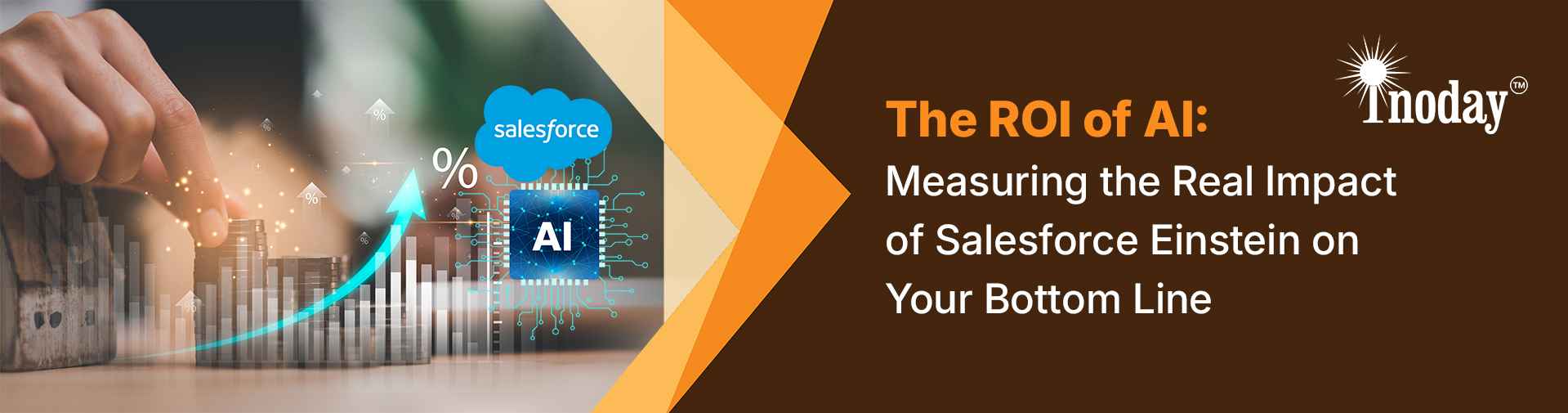
Today, artificial intelligence has moved beyond its experimental phase and has delivered business value. For companies employing CRM tools as a growth driver, Salesforce Einstein ROI is no longer an intellectual conversation; it has entered the world of corporate performance.
Today, a relevant question is being raised by top-level executives: How can we quantify the value that AI delivers on revenues, expenses, and productivity?
This is what Salesforce Einstein does differently. Einstein is integrated and built right into the Salesforce platform. It uses artificial intelligence to turn data into predictions, recommendations, and actual automated actions.
Why Measuring Salesforce Einstein Impact Matters
Adopting AI without measurement is simply innovation theater. In order to consume more costs on it, it is necessary to somehow trace its results from the AI. The Measuring Salesforce Einstein Impact helps to align all AI projects with such organizational objectives as revenue, cost, and satisfaction.
Unlike other AI tools, Einstein is integrated into the CRM process. This increases the simplicity of performance measurements and ensures the ability to attribute benefits directly to AI-driven decisions—an essential foundation for how to measure Salesforce Einstein ROI accurately.
Understanding Salesforce Einstein’s Value Drivers
To evaluate Salesforce Einstein’s value, it is important to identify where it is created
- Predictive Insight: Salesforce Einstein can help improve your pipeline accuracy and revenue predictability.
- Personalized Recommendations: With increased conversion & velocity in Deal Execution.
- Automating at Scale: Salesforce Einstein can eliminate manual effort (data entry, case classification and follow-up).
- Smarter Service: AI driven Case Routing and Sentiment Analysis can decrease resolution time and enhance customer loyalty.
Together, these four functions move the needle on both top line revenue growth and operational efficiency.
Key Einstein AI ROI Metrics to Track
Defining the right Einstein AI ROI metrics is critical. Successful organizations focus on metrics that map AI performance to financial outcomes:

Aggregated, these metrics will show a clear picture of Salesforce Einstein ROI.
How to Measure Salesforce Einstein ROI in Practice
A structured approach is essential for how to measure Salesforce Einstein ROI effectively:
- Baseline Before AI: It captures pre-Einstein benchmarks regarding the sales, services, and marketing area.
- Align AI Use Cases with KPIs: Einstein functionalities (forecasting, recommendation, and automation) with business KPIs like revenue growth and cost savings.
- Track Incremental Improvements: Monitor progress over time and segregate improvements caused by AI from other factors.
- Translate Performance into Financial Value: The key here is to quantify improvements in productivity and efficiency by putting a price on them—this is where the financial impact of AI initiatives becomes relevant to the executive team.
Salesforce Agentic AI: The Next Evolution of ROI
The emergence of Salesforce agentic AI marks a significant leap forward. Unlike traditional AI that reacts to inputs, agentic AI systems can plan, decide, and act autonomously within defined boundaries.
This vision comes to life with Salesforce Agentforce AI, where AI agents can:
- Follow up on leads proactively.
- Resolve service cases without human intervention.
- Coordinate activities across departments.
From an ROI perspective, Agentforce amplifies value by multiplying at scale. One AI agent can undertake the work of many users—dramatically improving cost efficiency and speed while consistency is maintained.
Connecting AI Investment to the Bottom Line
Ultimately, the Salesforce Einstein bottom line impact lies in its ability to turn data into decisions and decisions into dollars. When the ROI can be accurately measured, collectively as an organization, AI becomes a revenue multiplier, not a cost driver.
When Einstein insights inform sales tactics, when service teams close cases quicker, and when marketing touches the right customer at the right time—the financial results will naturally follow.
Final Thoughts: Turning AI into Measurable Business Value
True power of AI is not in its complexity, but in the results it produces. True value of AI is reflected in the ROI that is measured through the right Einstein AI ROI metrics, aligning the power of AI with the objectives of the business, and through adoption of innovative solutions such as the use of Salesforce Agentforce AI.
In the data-driven economy, people who know how to measure the impact of AI will not only leverage AI but will outcompete their rivals through the use of AI.