For many organizations, SAP ECC has been a trusted ERP platform for years. It manages critical business functions, supports day-to-day operations, and continues to do what it was designed to do.
So why are so many businesses evaluating alternatives?
The answer isn’t that SAP ECC suddenly stopped working. The answer is that business requirements have changed.
Today’s organizations need real-time visibility, faster decision-making, connected business processes, scalable operations, and the ability to adapt without adding complexity.
As growth accelerates and business models evolve, many companies are discovering that maintaining existing ERP environments often requires increasing effort, higher costs, and too many workarounds.
The conversation is no longer about replacing the system. It’s about determining whether the current ERP can support the next stage of business growth.
When Stability Becomes the Problem
One of the biggest misconceptions in ERP modernization is that organizations only upgrade when their ERP fails.
In reality, most modernization initiatives begin while the existing system is still functioning.
The concern is rarely stability. The concern is agility.
Business leaders begin noticing that operational changes take longer, reporting requires additional effort, integrations become increasingly complex, and teams rely on spreadsheets to bridge information gaps.
The ERP continues to run. The business simply starts moving faster than the ERP can support.
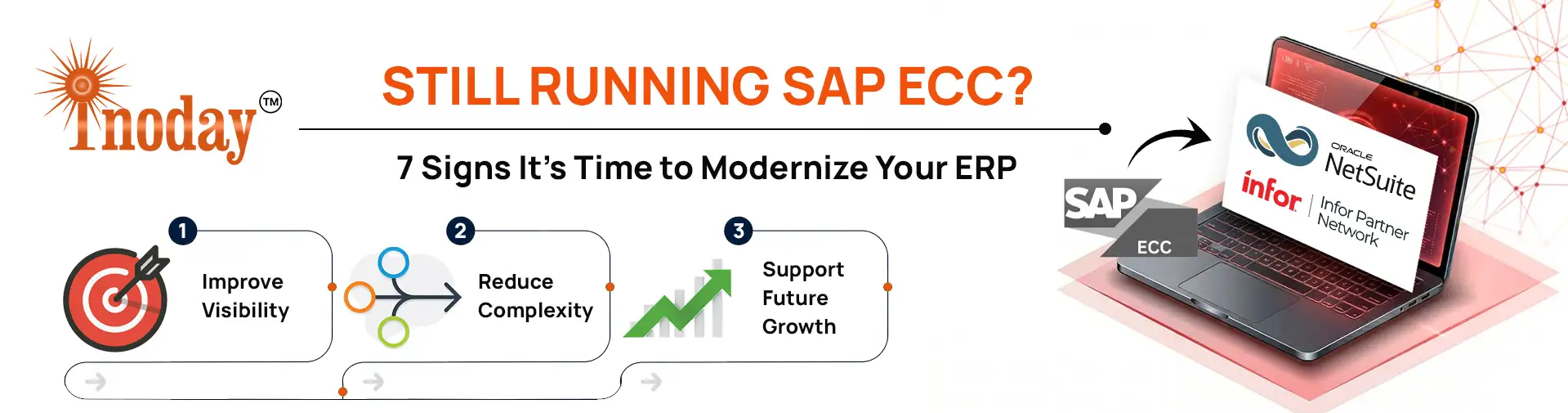
7 Signs Your Organization May Have Outgrown SAP ECC
1. Spreadsheets Have Become Part of the ERP Strategy
If finance, operations, procurement, inventory, or supply chain teams rely on spreadsheets every day, it’s worth asking why.
Many organizations maintain spreadsheets for:
- Management reporting
- Inventory planning
- Budget tracking
- Demand forecasting
- Procurement monitoring
- Consolidation activities
The more spreadsheets required to run the business, the further teams move away from a single source of truth.
Instead of improving visibility, employees spend valuable time validating data and reconciling numbers.
2. Reporting Answers Yesterday's Questions
Leadership teams need visibility in real time.
Unfortunately, many organizations still spend significant effort:
- Extracting data
- Consolidating reports
- Validating information
- Preparing management dashboards
By the time reports reach decision-makers, the information is often historical rather than actionable.
Modern ERP environments help organizations shift from reporting on what happened to understanding what is happening now.
3. Every Integration Requires Significant Effort
Business applications continue to expand.
Organizations now operate across:
- CRM platforms
- E-commerce channels
- Banking systems
- Warehouse solutions
- Analytics platforms
- AI-powered applications
When connecting systems becomes increasingly expensive, time-consuming, or dependent on custom development, innovation slows.
Technology should enable change, not create barriers to it.
4. Customization Has Become Technical Debt
Many SAP ECC environments have been customized extensively over the years.
Initially, customizations solve business problems.
Over time, they can create complexity.
Organizations often struggle with:
- Maintaining custom developments
- Supporting legacy integrations
- Managing upgrade challenges
- Retaining specialized system knowledge
The result is a system that becomes harder to evolve as business needs change.
5. Growth Is Creating Operational Complexity
Growth should create opportunity.
Instead, some organizations find themselves creating new manual processes to support expansion.
Common challenges include:
- Multiple entities
- New locations
- Additional business units
- International operations
- Increased transaction volumes
When growth introduces operational friction rather than efficiency, it may be time to reassess the ERP foundation supporting the business.
6. Teams Spend More Time Managing Processes Than Improving Them
Many organizations still rely on manual effort for:
- Approvals
- Reconciliations
- Procurement workflows
- Financial close activities
- Inventory updates
- Data transfers between systems
The cost isn’t limited to productivity.
Manual processes also reduce visibility, increase risk, and make scaling more difficult.
7. Business Strategy Is Moving Faster Than Technology
Today’s leadership teams are investing in:
- Data-driven decision-making
- Artificial intelligence
- Process automation
- Advanced analytics
- Customer experience initiatives
- Digital transformation programs
The challenge is not whether these initiatives are valuable.
The challenge is whether existing systems can support them efficiently.
When technology becomes the constraint, modernization becomes a business priority rather than an IT initiative.
The Real Question Isn't ``What Replaces SAP ECC ?``
Many ERP evaluations start with the wrong question.
Organizations often ask: “What should replace SAP ECC?”
A better question is: “What does our business need from its next ERP platform?”
The answer varies from organization to organization. Some businesses prioritize financial visibility. Others require advanced manufacturing functionality.
Some need multi-entity management, while others focus on operational scalability and process automation.
The objective should never be replacing software for the sake of replacement. The objective should be enabling future growth.
Why Businesses Are Evaluating Oracle NetSuite and Infor M3
As organizations modernize their ERP environments, Oracle NetSuite and Infor M3 frequently emerge as leading options because they address challenges many growing businesses face today.
Oracle NetSuite
Businesses evaluating Oracle NetSuite are typically seeking:
- Unified business visibility
- Multi-entity management
- Process automation
- Real-time reporting
- Cloud accessibility
- Faster deployment and scalability
For organizations managing growth across multiple functions, NetSuite provides a single platform that connects finance, operations, inventory, procurement, and customer information.
Infor M3
Infor M3 is often preferred by organizations with complex operational requirements, particularly across manufacturing and distribution environments.
Key strengths include:
- Manufacturing operations
- Production planning
- Supply chain management
- Inventory optimization
- Distribution management
- Industry-specific functionality
For businesses with operationally intensive environments, Infor M3 delivers deep functionality designed around industry processes.
Modernization Is Not About Technology. It's About Business Outcomes.
Successful ERP modernization projects rarely start with software demonstrations.
They start with business questions.
Questions such as:
- Where are operational bottlenecks occurring today?
- Which processes limit productivity?
- Where is visibility lacking?
- What is preventing faster decision-making?
- What does the business need to achieve over the next five years?
When those questions are answered first, technology decisions become much clearer.
Choosing the Right Path Forward
ERP modernization does not have a universal answer.
The right decision depends on:
- Business strategy
- Industry requirements
- Operational complexity
- Growth objectives
- Integration needs
- Long-term scalability expectations
The goal is not to select the most popular ERP.
The goal is to identify the platform that best aligns with how the business intends to grow.
That is where experienced ERP evaluation and transformation guidance can make a significant difference.
How inoday Helps Organizations Evaluate Their Next ERP Strategy
At inoday, we work with organizations that have reached an important crossroads. Their ERP system still functions. The business continues to operate.
Yet leadership teams recognize that future growth may require a different technology foundation. Rather than beginning with software recommendations, we focus on understanding business objectives, operational challenges, process complexity, reporting requirements, and growth plans.
This allows organizations to evaluate ERP modernization options with clarity and confidence. Whether the outcome points toward Oracle NetSuite or Infor M3, the objective remains the same:
Helping businesses improve visibility, simplify operations, support growth, and maximize long-term value from their ERP investment.
Final Thoughts
SAP ECC has served organizations exceptionally well for many years.
The question facing business leaders today isn’t whether SAP ECC has delivered value. The question is whether it can continue delivering value as business expectations evolve.
If reporting takes too long, processes remain manual, integrations have become complicated, or growth is introducing operational complexity, it may be time to evaluate what comes next.
Because the most successful ERP decisions are not driven by technology. They’re driven by business goals.
Is your ERP helping you achieve them?