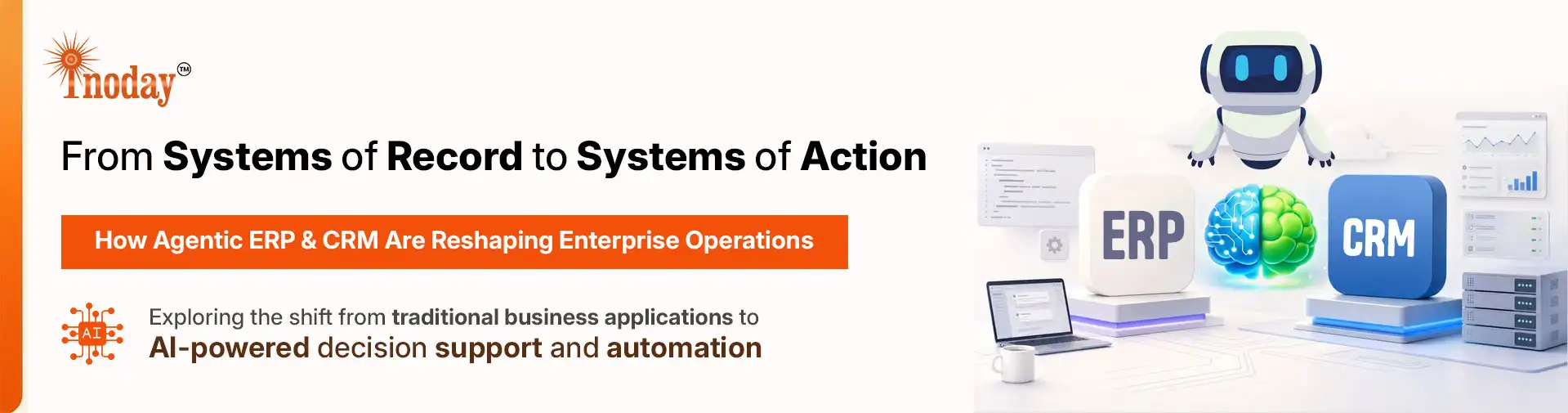
Agentic ERP and CRM represent the next evolution of enterprise software, moving organizations from systems of record to systems of action. Artificial Intelligence has quickly moved from innovation agendas to boardroom discussions.
Business leaders across industries are exploring AI copilots, intelligent assistants, autonomous workflows, and digital agents that promise to improve productivity, reduce manual effort, and accelerate decision-making.
Yet despite growing interest in AI, many organizations remain focused on the wrong question:
“How do we implement AI?”
The better question may be:
“Is our business ready for AI?”
While much of the market’s attention is focused on intelligent agents, copilots, and automation platforms, the reality is that successful AI adoption depends less on the technology itself and more on the operational foundation supporting it.
Poor data quality, disconnected systems, fragmented processes, and limited visibility remain significant barriers to realizing the full value of AI-powered business applications.
This is where the conversation around Agentic ERP and CRM becomes increasingly important.
Organizations are no longer looking for systems that simply store information. They are looking for systems that can interpret information, recommend actions, automate repetitive work, and support better business outcomes.
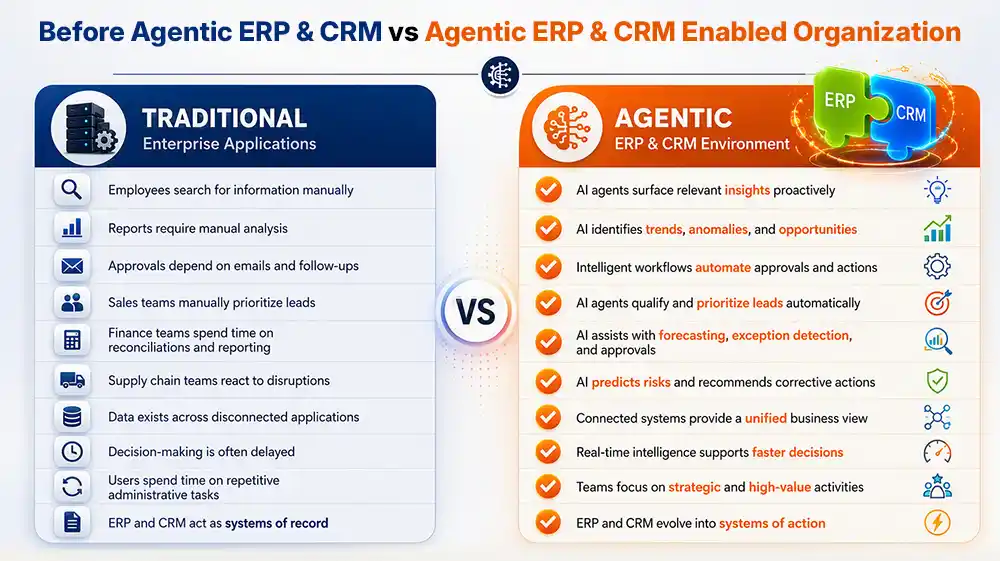
The future of enterprise technology is evolving from systems of record to systems of action.
Beyond Digital Transformation: The Rise of Agentic ERP and CRM
1. Spreadsheets Have Become Part of the ERP Strategy
For years, ERP and CRM initiatives focused on digitization.
Businesses implemented systems to:
- Centralize information
- Improve visibility
- Standardize processes
- Strengthen reporting
- Improve operational control
These initiatives created the foundation for modern business operations.
However, most organizations still rely heavily on employees to perform tasks such as:
- Reviewing reports
- Processing approvals
- Updating records
- Prioritizing leads
- Responding to service requests
- Managing follow-ups
- Monitoring inventory
- Identifying operational risks
The next phase of enterprise software introduces intelligent agents capable of helping users perform these activities more effectively.
Agentic business applications combine ERP, CRM, AI, and automation capabilities to help organizations move from reactive operations to proactive operations.
Instead of simply displaying information, these systems can:
- Analyze business data
- Identify patterns
- Surface recommendations
- Trigger actions
- Automate workflows
- Support decision-making
The result is a more intelligent and responsive business environment.
Most Organizations Are Not AI Ready Yet
One of the biggest misconceptions surrounding AI adoption is the belief that implementing an AI solution automatically delivers business value.
In reality, organizations often struggle with much more fundamental challenges.
Many businesses still face:
- Data duplication across systems
- Siloed ERP and CRM applications
- Spreadsheet-driven reporting
- Disconnected business processes
- Inconsistent master data
- Limited workflow automation
- Low ERP and CRM adoption rates
Adding AI on top of fragmented processes does not eliminate inefficiency.
In many cases, it simply exposes it faster.
At inoday, we believe successful AI adoption starts with operational readiness.
Organizations that generate the greatest value from AI are typically the organizations that have already invested in:
- Process standardization
- Data quality
- Application integration
- Business visibility
- Governance frameworks
- User adoption
Before businesses deploy intelligent agents, they should first ensure their operational foundation can support them.
What Is Agentic CRM?
Traditional CRM systems help organizations store customer information, manage activities, and track opportunities.
Agentic CRM extends these capabilities through intelligent assistance and automation.
Rather than acting as a passive customer database, CRM platforms can now help sales, marketing, and service teams make faster and better decisions.
Smarter Lead Qualification
Sales teams often spend significant time reviewing incoming leads.
Agentic CRM solutions can:
- Analyze lead quality
- Evaluate engagement signals
- Prioritize prospects
- Recommend next actions
- Assist with follow-ups
This reduces administrative effort while helping sales teams focus on high-value opportunities.
Opportunity Intelligence
Managing sales pipelines requires constant analysis.
AI-powered CRM environments can:
- Surface deal risks
- Highlight buying signals
- Recommend engagement strategies
- Improve forecast accuracy
Instead of manually analysing large volumes of information, sales teams can focus on building customer relationships and accelerating deal progression.
Customer Service Transformation
Support teams are increasingly expected to resolve issues faster while maintaining high service quality.
Agentic CRM solutions can help:
- Route requests intelligently
- Surface relevant knowledge articles
- Recommend responses
- Support service agents
- Improve case resolution efficiency
This enhances both employee productivity and customer experience.
What Is Agentic ERP?
ERP systems manage core business functions such as finance, procurement, inventory, manufacturing, supply chain, and operations. Agentic ERP extends traditional automation by using AI-powered agents to support decision-making, identify exceptions, recommend actions, and streamline workflows.
Finance & Accounting
Finance teams often spend significant time on forecasting, reconciliations, approvals, and reporting. Agentic ERP can assist with:
- Financial planning
- Forecasting
- Variance analysis
- Exception detection
- Approval management
This enables finance teams to focus more on strategic decision-making and business planning.
Supply Chain & Operations
Modern supply chains require greater agility and visibility. Agentic ERP helps organizations:
- Predict demand changes
- Monitor inventory risks
- Improve procurement planning
- Identify operational exceptions
- Recommend corrective actions
This improves operational responsiveness and resilience.
Order-to-Cash Optimization
Agentic ERP streamlines critical business processes, including:
- Order processing
- Inventory allocation
- Fulfillment management
- Shipment tracking
- Revenue management
Reducing manual intervention helps improve efficiency, accuracy, and customer satisfaction.
The AI Readiness Framework Every Organization Should Assess
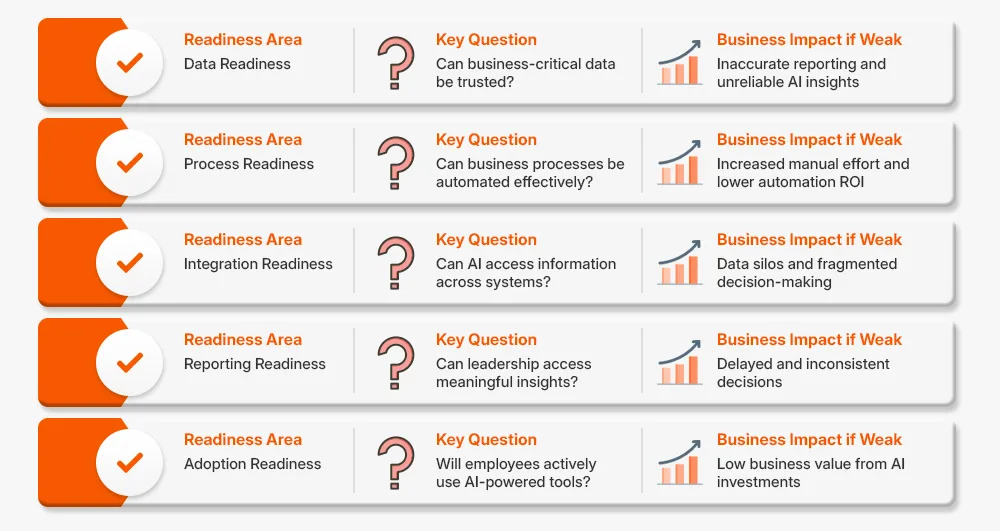
Before pursuing intelligent agents and autonomous business processes, organizations should evaluate their readiness in five key areas.
1. Data Readiness
Can business-critical data be trusted?
Impact: Poor data quality can lead to inaccurate insights, unreliable reporting, poor decision-making, and reduced effectiveness of AI and automation Solutions.
Questions to consider:
- Is data accurate?
- Is master data consistent?
- Are duplicate records controlled?
- Is information updated regularly?
2. Process Readiness
Can business processes be automated effectively?
Impact: Inconsistent processes and manual workarounds can increase operational effort, delay decision-making, and limit the value of automation and AI initiatives.
Organizations should evaluate:
- Process consistency
- Workflow standardization
- Process ownership
- Existing manual workarounds
3. Integration Readiness
AI requires access to information across systems.
Impact: Disconnected systems often result in fragmented data, delayed decision-making, inefficient workflows, and limited business value from AI and automation initiatives.
Businesses should evaluate:
- ERP integrations
- CRM integrations
- Ecommerce integrations
- Warehouse and logistics integrations
- Third-party application connectivity
4. Reporting Readiness
Can leadership access meaningful business insights?
Impact: Limited visibility and inconsistent reporting can slow decision-making and reduce the value of AI-driven insights.
Organizations should assess:
- KPI consistency
- Reporting quality
- Dashboard usability
- Data visibility
5. Adoption Readiness
Technology only creates value when people use it.
Impact: Low adoption can limit productivity gains, slow transformation efforts, and prevent organizations from realizing the full value of AI, automation, and digital investments.
Organizations should evaluate:
- User adoption rates
- Training effectiveness
- Change management maturity
- Business ownership
Why AI Readiness Will Become a Competitive Advantage
The race toward AI adoption has begun.
However, businesses that focus exclusively on technology risk overlooking the operational foundations required for success.
Over the next few years, the greatest competitive advantage will not belong to organizations implementing the most AI tools.
It will belong to organizations that:
- Build cleaner data environments
- Strengthen integrations
- Standardize processes
- Improve visibility
- Enable employees effectively
These organizations will be positioned to scale AI initiatives faster and achieve measurable business outcomes.
How inoday Helps
At inoday, we help organizations build the business foundations required to support intelligent enterprise operations.
Our expertise spans:
- Oracle NetSuite
- Microsoft Dynamics 365
- Infor Solutions
- ERP Consulting
- CRM Solutions
- Application Integrations
- Business Intelligence
- AI & Automation
- Digital Transformation
We help businesses assess operational maturity, improve process efficiency, strengthen integrations, enhance reporting, and prepare for future AI initiatives.
Whether your goals involve ERP modernization, CRM transformation, automation, analytics, or AI readiness, successful outcomes begin with creating a connected and scalable business environment.
Conclusion
The future of enterprise software is not simply about implementing AI.
It is about creating businesses that are ready to benefit from AI.
Agentic ERP and CRM solutions represent a major shift in how organizations operate, helping teams move beyond data management and toward intelligent decision-making, automation, and execution.
However, the organizations that derive the greatest value from this shift will be those that first invest in the fundamentals:
Because in the age of intelligent business applications, AI readiness may prove more important than AI adoption itself.
- Clean data
- Connected systems
- Standardized processes
- Strong governance
- Operational visibility
Ready to Assess Your AI Readiness?
Discover how inoday can help prepare your ERP, CRM, data, and business processes for the next generation of intelligent enterprise applications.